
The Great Trim Debate: Grounding the Floor vs. Elevating the Ceiling
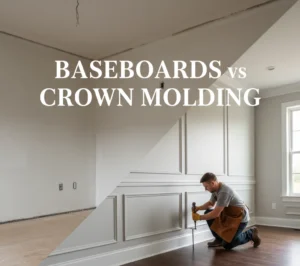
When embarking on a home renovation in 2026, homeowners often face a classic design dilemma: where should the budget for finish carpentry go first? While both elements are essential to a polished interior, baseboards and crown molding serve very different psychological and structural roles.
Baseboards are the foundation of a room, providing a necessary transition between the wall and the flooring. Crown molding, on the other hand, is the crowning achievement that draws the eye upward and defines the architectural height. Choosing between them requires an understanding of how light, shadow, and scale interact in your specific space.
At LG Construction & Remodeling, we often see clients in Fitchburg and Worcester County struggling to decide which upgrade provides the most “wow factor.” The truth is that the “biggest” impact depends entirely on your room’s existing proportions and your long-term aesthetic goals.
This guide explores the technical and visual nuances of these two interior trim powerhouses. We will look at why one might be more critical than the other for your specific residential construction project, helping you make an informed decision for your Massachusetts home.
The Power of Baseboards: More Than Just a Floor Border
Often overlooked, the baseboard installation is actually the most hardworking element of your home’s trim package. It isn’t just a decorative strip, it is a functional barrier that protects your drywall from vacuums, mopping, and foot traffic.
In 2026, the trend has shifted toward taller, more substantial baseboards. The thin, two-inch “clamshell” trim of the past is being replaced by five to seven-inch profiles that provide a sense of weight and permanence. This shift creates a “grounded” feeling that makes a room feel more expensive and structurally sound.
Why Baseboards Are Non-Negotiable
If you are choosing between the two for a limited budget, the floor-level trim usually wins on practicality. Without it, the gap between your flooring and the wall remains exposed, leading to moisture issues and an unfinished appearance.
Durability: High-quality woodworking at the floor level prevents dents in the drywall.
Visual Anchoring: Darker or larger baseboards can make a vast room feel more intimate.
Seamless Transitions: They hide the expansion gaps required for hardwood and laminate flooring.
Popular Baseboard Styles for 2026
| Style | Visual Profile | Best For |
| Craftsman | Flat, simple lines with square edges | Modern Farmhouse, Minimalist homes |
| Colonial | Traditional curves and stepped ridges | Historic New England residences |
| Modern High-Profile | Extremely tall (7″+), thin, and flat | Luxury apartments and high-ceiling lofts |
| Sculpted | Intricate Victorian-style patterns | Formal dining rooms and entryways |
The Majesty of Crown Molding: Elevating the Room’s Horizon
While baseboards ground a room, crown molding is what truly “finishes” a space. It acts as the visual frame for the entire room, softening the harsh 90-degree angle where the wall meets the ceiling.
Installing crown molding is a signature move in high-end interior design. It immediately signals that the home was built with an eye for detail. For homes in the Boston and Cambridge areas with high ceilings, this detail prevents the room from feeling like a giant, empty box.
The Architectural Benefits of Ceiling Trim
Crown molding creates a “lift” effect. By painting the molding the same color as the ceiling, you can trick the eye into thinking the walls are taller than they actually are. Conversely, painting it a contrasting color defines the room’s geometry with sharp precision.
Shadow Lines: It adds depth by creating natural shadows that change throughout the day.
Hiding Imperfections: It is perfect for concealing cracks or unevenness where the wall and ceiling meet.
Increased Property Value: Homes with professional finish carpentry at the ceiling level consistently appraise higher.
Choosing the Right Proportion
The biggest mistake in remodeling is choosing a crown that is too small for the ceiling height. A standard eight-foot ceiling usually requires a 3 to 4-inch crown, while a ten-foot ceiling can easily handle a 7-inch or even a multi-piece “built-up” molding.
Comparing Visual Impact: Which One Wins?
To decide what makes the biggest impact, we must look at the “intent” of the room. A master carpenter evaluates the space before making a recommendation. If the room has beautiful hardwood floors, the baseboard should be the star. If the room has stunning chandeliers or vaulted ceilings, the crown molding takes priority.
The Case for Baseboards
If your home has standard 8-foot ceilings, oversized crown molding can actually make the room feel cramped. In this scenario, upgrading to a premium, thick baseboard installation provides a luxury feel without encroaching on the perceived vertical space.
The Case for Crown Molding
In formal areas like dining rooms or foyers, crown molding almost always wins the “impact” contest. It is the first thing people notice when they enter because it sits at eye level or higher, dominating the upper field of vision.
Technical Challenges: The Art of the Perfect Joint

Neither of these upgrades will look good if the joints are sloppy. This is where LG Construction & Remodeling applies our “Craftsmanship Core.” Massachusetts homes, especially historic ones in Worcester County, often have walls that have settled and are no longer square.
The Precision of Coped Corners
As mentioned in our technical guides, we don’t just “miter” corners at 45 degrees. We use coped joints for inside corners. This ensures that when the wood moves during the humid New England summers and dry winters of 2026, the joints remain tight and invisible.
Scribing to the Floor and Ceiling
Floors are rarely level. A professional finish carpenter will “scribe” the bottom of a baseboard to follow the exact contour of the floor. This eliminates the need for ugly “shoe molding” or “quarter round” in many cases, leading to a much cleaner, more modern look.
Essential Materials: Wood vs. Composite for 2026
The choice of material affects both the visual impact and the longevity of the work. For residential remodeling, we typically help our clients choose between three main options:
Solid Poplar or Pine: Ideal for paint-grade finishes. It is more durable than MDF and holds a crisp edge.
MDF (Medium Density Fiberboard): The most stable option. It doesn’t expand or contract as much as wood, making it perfect for long runs of crown molding.
Hardwoods (Oak, Cherry, Walnut): Used for stain-grade custom millwork. This is for homeowners who want the natural grain to be the focal point of the room.
Material Durability Table
| Material | Impact Resistance | Moisture Stability | Best Use |
| MDF | Low | High | Crown Molding |
| Finger-Jointed Pine | Medium | Medium | Window/Door Casing |
| Poplar | High | Medium | Baseboards |
| Solid Oak | Very High | Low | High-Traffic Baseboards |
Planning Your 2026 Renovation Project
If you are planning to upgrade your finish carpentry, timing is everything. Ideally, these elements should be installed after the flooring is down but before the final coat of paint. This allows the carpentry contractor to ensure every nail hole is filled and every seam is caulked for a monolithic, high-end appearance.
The Holistic Approach
Why choose one? The best visual impact comes from a “layered” approach. By coordinating your baseboards, door casings, and crown molding, you create a cohesive architectural language. This is what we call structural carpentry for the eyes.
Local Expertise Matters
Working with a local business like LG Construction means you get advice tailored to the specific architecture of the Northeast. Whether it is a colonial home in Lexington or a modern condo in Somerville, the trim should respect the building’s soul.
LG Construction & Remodeling: Primary Service Areas
We provide elite finish carpentry services across Massachusetts and New Hampshire. Our team is dedicated to precision in every cut and every corner. Find us in your local area:
Final Verdict: Which One Should You Choose?
If your goal is immediate “luxury” and your ceilings are at least 9 feet tall, crown molding makes the most significant visual impact. It is the architectural exclamation point of a room.
However, if you are looking for a complete transformation that feels grounded and modern, upgrading to 7-inch baseboards is the smarter, more practical investment. In many 2026 designs, we are seeing homeowners skip the crown molding entirely in favor of ultra-high, clean-lined baseboards for a “gallery” look.
No matter which path you choose, the key is execution. A poorly installed crown is worse than no crown at all. Trust the experts who specialize in fine woodworking and understand the nuances of New England home structures.
Ready to Transform Your Home?
Don’t leave your home’s character to chance. Whether you want to ground your space with bold baseboards or elevate it with elegant crown molding, we are ready to help.
Contact LG Construction & Remodeling Today
Call us at: (978) 906-9676